
Sometimes You Need to Sink to Survive

We have had 67 students quit or not renew their memberships since March 12. This number is more than a quarter of our current student base. We currently have five members who still have memberships but have not paid their tuition. This is a situation that doesn’t look so well right now.

In second phase of SEAL training there is an evolution called “drown-proofing.” It is where they bind your hands behind your back, tie your feet together, and dump you into a 9-foot-deep pool. Your job is to survive for five minutes. I also did this at Search and Rescue School where the majority of us who attempted drown-proofing, the first time, failed. (Took me four attempts.)
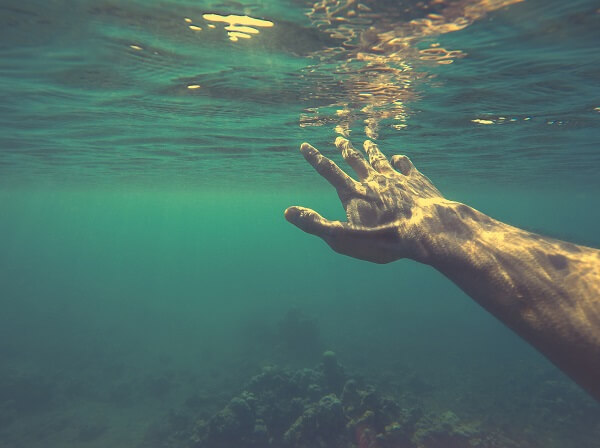
Sinking to Survive

Upon being tossed into the water, many of us panicked and screamed to be lifted back out. Some struggle until they slip underwater where they proceed to lose consciousness and have to be fished out and resuscitated. BM1 Terry (my class proctor) told me that the only way to make it was to understand these two counterintuitive lessons:

Lesson 1: It’s a paradox: the more you struggle to keep your head above water, the more likely you are to sink.

It is impossible to keep yourself on the surface for the full five minutes with your arms and legs bound. Your attempts to keep your body afloat will only cause you to sink faster. The trick to drown-proofing is to actually let yourself sink to the bottom of the pool. From there, you lightly push yourself off the pool floor and let your momentum carry you back to the surface. Once there, you can grab a quick breath of air and start the whole process over again. Strangely, surviving drown-proofing requires no superhuman strength or endurance. It doesn’t even require that you know how to swim. On the contrary, it requires the ability to not swim. Instead of resisting the physics that would normally kill you, you must surrender to them and use them to save your own life.

Lesson 2: While obvious, still a paradox: the more you panic, the more oxygen you will burn and the more likely you are to fall unconscious and drown.

In a sick and twisted way, the exercise turns your survival instinct against you: the more intense your desire to breathe, the less you will be able to breathe. The more intense your will to live, the greater the chance you will die. It is more than a test of physical will; it is a test of your emotional self-control in situations of extreme danger. Can you control your own impulses? Can you relax in the face of potential death? Can you willingly risk your life in the service of some higher value or goal? These skills are far more important than anyone’s ability to swim. They are more important than your physical toughness or ambition. They are more important than how smart you are or what school you went to.

This skill is the ability to let go of control when one wants it most, and it is one of the most important skills anyone can develop.

 I say all that to say this:

IF WE WANT TO GET TO THE SURFACE FOR A BREATH OF AIR…

FIRST, WE MUST SINK.

One way or another we are going to get through this. The Academy is going to go on. Yes, we are sinking…but we have to remain calm in order to survive. I am going to secure a personal loan to take care of the rent difference in May. The Landlord is trying to take advantage of us during this period by offering no rent for May, June and possibly July if I sign a 5-year lease extension. He will get no such satisfaction from his efforts to manipulate the situation.

You might be experiencing the same in your life right now: finances, job, work, school, etc. There is a time to fight and then there is a time to relax.

Wash your hands, be safe, repeat;

Mr. Scott Baker

Martial Arts Habits That Stick | Practice Makes Permanent

Why Training Habits Matter in Martial Arts and Life

What one thing do winners do that tie everything together? It makes sense to encourage kids to go out and do something they love. Research shows that people are more satisfied when they do something that fits their personal passions. While it is impossible to be fascinated with everything, everyone is fascinated with something. With that said, having your child change their activities like old clothes might not be the best option. In martial arts, training habits are everything. The phrase ‘practice makes permanent’ teaches that repetition builds character and skill.

There are many benefits of sticking it out with something new. Sometimes children don’t realize how fun it is until they get a little further into it. Kids need their fires stoked from time to time. Passion in kids is not the same as in adults. Kids need outside motivation when times get rough and the challenges become difficult.

Now your child is interested in an activity, what’s next? Practice, Practice, Practice.

Goals and Success

Practice does not make perfect as some people claim, practice makes permanent. Only perfect practice makes perfect. Running around a baseball field until your child collapses is not necessarily improving their skills. How do Olympic athletes’ practice? They strive to improve their specific problems. If you have a flat tire, you don’t replace the vehicle…you fix the tire.

It is with great focus and determination that these athletes achieve their goals. Perseverance is going to make your dreams come true. Either you are working hard to accomplish your dreams or you will be working for someone else to accomplish theirs.

If you are an adult working toward a goal, don’t give up! If you are a parent helping a child find and develop their passions, continue to encourage them and don’t let them give up either!

If TaeKwonDo is your passion or possibly your child’s passion, we can help you or your child develop the skills needed to be successful with it. To learn more about our martial arts training and classes, contact us.

POW Life Lessons | Discipline & Resilience in Martial Arts

What Martial Artists Can Learn From POWs

Let me tell you a story about Lanny Bassham. He was an Olympic marksman shooter in the 1972 Olympics in Munich. At just 25, he was already the youngest world champion in that sport and odds in favor to take the gold that year. He took silver instead. He had overheard some Russians talking about how the pressure to take gold must be so great, and it really messed with his mind and he choked. Lanny said his definition of silver medal became, “the very best you can possibly do and still lose.” He suffered with this disappointment for many years. Discipline from military experience often translates directly into martial arts training — especially when learned from someone who’s endured captivity.

Then in 1974 he met a man who changed his life forever. He counts a story in his book Freedom Flight, where he calls the man Jack Sands. The guy’s real name was Jack Fellows. He talks about how Jack was shot down over Vietnam and spent six years as a Prisoner of War at the famous POW camp known as Hanoi Hilton. Six years later he was finally released and flown back to San Diego where they put him in an ambulance to get him over to Balboa Hospital. He barely weighed 100 pounds since he had been in a prison camp for six years with awful conditions.

Lessons from a POW

As they headed to the hospital, they drove past the golf course by the back gate of Naval Air Station North Island. Suddenly Jack called out, “Wait, stop the ambulance!” What? The ambulance driver pulled over, alarmed. Was this guy dying or something? “Let me out for a bit,” said Jack. “I’ve got to play some golf.” The driver looked at him like he was crazy, but Jack insisted as he was the returning hero.

The driver let him out of the ambulance and took him over to the golf course clubhouse, where the club members at first refused to let him play and tried to throw him out. He explained who he was, and that he been holed up in the worst imaginable prison in north Vietnam for more than six years, and that he really wanted to get out on the green and play a round of golf. Most of these guys were vets themselves. They took pity on Jack and brought him around to the pro shop to get outfitted, meanwhile shooting each other nervous looked behind Jack’s back. This guy was absolutely in terrible shape. Not much more than skin and bones, and could barely walk on his own.

Jack went out onto the green and shot par on the first hole. And then the second hole. And then the third. His drives were ripping down the fairway, every time. His putts were perfect. He shot par on all 18 holes. The club regulars all stared at him like he was from outer space. This guy hadn’t been on the golf course in years. He hadn’t even seen grass in years! He’s been wasting away in a tiny cell. What he just did simply wasn’t possible. Yet they watched him do it.

“Pardon me for asking, Commander,” said one of the clubbers, “but how did you do that?” Jack just said, “Gents I’ve played thousands of rounds of golf in my head over the past six years and let me tell you, it’s been a long, long time since I’ve missed a putt.”

That’s how the man kept himself sane during this long stretch as a POW. He would sit in his tiny cell, build pictures in his head of all his favorite courses, and then he walked through them, playing round after round of golf. Every day, for six years. He hadn’t physically been on the golf course for at least six years, but he’d mentally rehearsed his game to the point of perfection, and done it so thoroughly that all his muscles and articulations knew exactly what to do.

I have told this story to the students on more than a couple of occasions. When the students in class are standing on the side waiting for their turn to test or demonstrate their technique, I ask them to close their eyes and picture themselves doing their form perfectly. Or in the case of sparring, how they would spar. This way their muscles will know exactly what to do when it’s their turn.

I say all this because right now with this virus pandemic going on, we are all isolated to our homes. What Jack said that changed the course of his life boils down to this:


  • If your
    environment and circumstances control your attitude, you’re in
    prison.

  • If you are in
    control of your thoughts and your attitude, then you’re free.

We share this with our students not just to inspire — but to help them understand that perseverance begins with attitude. Keep the right attitude while this is going on and you will come out better and stronger on the other side!

Build Strong Communicators With Martial Arts Training

Why Martial Arts Builds Better Communicators

On May 13, 2003, the United States Bureau of Engraving and Printing introduced a new twenty-dollar bill into circulation. The new bill incorporated advanced security features in an attempt to stay one step ahead of currency counterfeiters. New features of the bill included a thin security thread imbedded in the bill, ink that changes color in changing light, watermarks that can be seen on both sides of the bill, and a redesigned portrait of Andrew Jackson.  In martial arts, communication isn’t just about talking — it’s about listening, presence, and clarity. These communication skills develop with every class.

Twenty Dollar Bill with Security Features

Official Federal Reserve notes (dollar bills) are the currency of our country; they are how we do business. If someone uses a counterfeit bill, the transaction is invalidated because no real money changed hands.

The currency of communicators is truth. The truth is what enables people to accomplish the “business” of friendship. If people do not communicate honestly, then trust is destroyed. Don’t be a communication counterfeiter in your relationships with your friends and family. When you speak, speak the truth. False words create a foundation of fantasies on which no house can permanently stand.

Want to improve your child’s confidence and communication? Enroll in a free trial class and watch them grow from the inside out.

Sink or Swim: Discovering Your Limits Through Challenge

You never truly know how far you can go until you’re in over your head. It’s like walking into the ocean — step by step, wave by wave — until suddenly, you realize the water is deeper, the current stronger, and your footing less certain. It’s in that moment, just past the comfort zone, that your true capabilities are revealed.

That lesson applies to life just as much as it does to the sea. Sometimes, you have to push yourself right up to the edge — and beyond — to find out what you’re made of. If you let the fear of failure hold you back, you’ll live with anxiety and regret. But if you’re willing to wade into the deep, you may discover you’re stronger than you think.

I learned this firsthand during Search and Rescue School. One of the most intense evolutions involved treading water for long periods — without the comfort of being near the pool’s edge. The instructors reminded us, “There is no edge when you’re in the middle of the ocean.”

We treaded water for ten-minute intervals, swam full laps, and returned to tread again. One Petty Officer Third Class began to struggle. He made a critical mistake: he said out loud, “I don’t think I can do this.” The instructors took that moment to teach a hard lesson.

Without warning, one instructor dove underwater, grabbed the struggling swimmer from behind, and pulled him down. It was a simulation — the kind of situation we could face in a real rescue when a panicked survivor might pull us under. The Petty Officer blacked out underwater and had to be pulled to safety by the same instructor. It was intense. It was real. It was a moment that taught everyone watching exactly how close the edge could be.

We began with 104 candidates. Only 16 graduated. Those 88 didn’t fail because they weren’t capable — they just hadn’t yet learned how to respond when failure met them face-to-face. Some of them would return to try again, this time better prepared. Some wouldn’t. But every one of them learned something valuable about their limits, their mindset, and the cost of fear.

Here’s the truth: failure will come. The question is, what will you do with it? You can carry it around like dead weight, dragging it with you, letting it define your story — or you can use it as a stepping stone to reach something higher. Either way, life doesn’t wait. It’s going to be sink or swim.


🥋 Ready to Swim?

If you want to build the skills, mindset, and resilience to swim — in the ocean and in life — consider TaeKwonDo training. At Virginia TaeKwonDo Academy, we help students of all ages and abilities discover confidence, strength, and discipline through structured martial arts training.

📞 Call us today at (757) 558-9869 or contact us to start your journey.